
Microdontia (Small Teeth): Effects on Looks, Bite and Treatment
Published: 2023-04-28 · Updated: 2026-11-22 · Medically reviewed by Katsuaki Takeuchi, DDS (Director; Board-certified oral surgeon, Japanese Society of Oral and Maxillofacial Surgeons)
What you will learn
- What microdontia is and where it tends to occur
- Effects on appearance, gaps and the bite
- Main treatment options such as resin, ceramics and orthodontics, and how to choose
Did you know that some teeth are much smaller than normal? This is called microdontia (small teeth). Because these teeth are smaller than the neighboring teeth or have a pointed tip, quite a few people come to us concerned about how they look.
In this article, we explain the features of microdontia, where it tends to occur, how it affects the mouth, and the main treatment options.
What is microdontia, and where does it occur?
Microdontia refers to teeth that are much smaller than normal. They are often shaped like a cone with a pointed tip, or like a tube, and are sometimes called "peg-shaped" or "conical" teeth.
The most common site is the second tooth from the center of the upper front teeth (the lateral incisor). It is also said to be common in wisdom teeth and in extra teeth that grow in addition to the normal number (supernumerary teeth). It may appear on only one side or on both sides.
Causes of microdontia
The exact cause of microdontia is not clear, but it is thought to be related to how the tissue that forms the tooth develops while the tooth is being made. Genetics are also said to play a role, and similar teeth are sometimes seen in other family members. It may also occur together with congenitally missing teeth (being born with fewer teeth).
Concerns with microdontia
Appearance and balance
When a lateral incisor is small, it may look pointed or much smaller than the neighboring teeth, making the front teeth look unbalanced. Because this area is easy to see when you smile, many people are concerned about the appearance.
Gaps between teeth
Because the tooth is small, gaps can form between it and the neighboring teeth. Gaps can make food get caught more easily, and sometimes make certain sounds, such as "s", harder to pronounce.
The bite
When microdontia occurs on only one side, the center line of the teeth may shift, or the upper and lower teeth may meet unevenly on the left and right. If the bite is badly misaligned, certain teeth or the jaw joints may come under extra strain.
Main treatment options for microdontia
Treatment for microdontia is chosen according to how much the appearance bothers you, the size of the gaps, and the condition of your teeth overall. The main options are as follows.
Reshaping with resin (direct bonding)
In this method, white resin (composite resin) is built up directly on the tooth, with little or no drilling, to adjust its shape and size. It is often completed in a single visit and places little burden on the tooth. However, compared with ceramics, resin may discolor or chip over time.
Ceramic crowns and laminate veneers
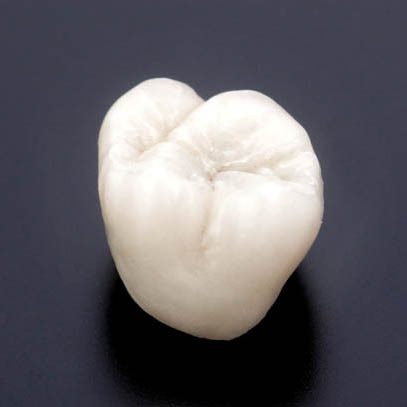
In this method, the tooth surface is shaved slightly and a thin ceramic shell (laminate veneer) is bonded to it, or the tooth is covered with a ceramic crown such as zirconia, to match the shape, size and color of the surrounding teeth. Ceramics are less likely to discolor and make it easier to achieve a natural look.
Combining with orthodontic treatment
If the gaps are large or you are concerned about the overall balance of your teeth, one option is to align the teeth with orthodontic treatment first and then finish the small tooth with a ceramic crown or similar restoration. Because the crown needs a space of just the right size, orthodontics is used to create that space. During orthodontic treatment, resin can also be added to the small tooth to make the gap less noticeable.
Summary
Microdontia means small teeth, often seen in the second tooth from the center at the top, and it can affect appearance, gaps and the bite. Treatment options include reshaping with resin, ceramic crowns or laminate veneers, and combining these with orthodontic treatment. The right method depends on the condition of your mouth and your wishes. If you are concerned about a small tooth, please feel free to consult us first.
ESCA Dental & Orthodontic Clinic is in the ESCA underground shopping mall, a 1-minute walk from the Shinkansen exit of JR Nagoya Station. Appointments by phone (+81-52-452-1255), online booking (Japanese) or LINE.
Main risks and side effects
- Treatments that reshape teeth with resin or ceramics may involve shaving the tooth, and the restoration may need to be remade because of sensitivity, chipping, debonding or discoloration
- Orthodontic treatment may cause pain or discomfort as the teeth move, a risk of tooth decay and gum disease, root shortening, gum recession, and relapse (teeth moving back)
Ceramic crowns, laminate veneers, direct bonding and orthodontic treatment are self-paid (not covered by insurance). Please see our fee table for standard costs.
Frequently asked questions
Q. Does microdontia have to be treated?
If you have no problems with appearance or your bite, it may be fine to leave it untreated. If it bothers you, we consider treatment according to your wishes.
Q. Can it be treated without drilling the tooth?
Direct bonding, which builds up resin to reshape the tooth, can often be done with little or no drilling. The right method depends on factors such as the size of the gaps, so please consult us.
Q. Is it better to treat it during childhood?
Until all the permanent teeth have come in, we often monitor the situation while watching how the teeth and jaws grow. If you are concerned about gaps or alignment, please come and see us.
Medical review
This article was reviewed by Katsuaki Takeuchi, DDS (Director; Board-certified oral surgeon, Japanese Society of Oral and Maxillofacial Surgeons), ESCA Dental & Orthodontic Clinic. It provides general information; please consult a dentist about your own condition.
Appointments and questions
Mon–Fri 10:00–13:00 / 14:30–19:30 · Sat & Sun 10:00–13:00 / 14:00–18:00 (open every other Sunday) · Closed on national holidays. Our staff mainly speak Japanese.