
Orthodontics or Whitening First? Timing and Tips by Appliance
Published: 2022-03-08 · Updated: 2026-11-22 · Medically reviewed by Katsuaki Takeuchi, DDS (Director; Board-certified oral surgeon, Japanese Society of Oral and Maxillofacial Surgeons)
What you will learn
- Three timings for whitening, and the recommended ones
- Differences by appliance: front braces, lingual braces and clear aligners
- Tips for keeping your teeth from looking dull during orthodontic treatment

We are often asked, "If I am straightening my teeth anyway, I would like to make them whiter too." Both the alignment and the color of your teeth have a big effect on how your smile looks.
Whitening can be considered before, during or after orthodontic treatment, but depending on the appliance there are times when it cannot be done. In this article we explain the features of each timing and points to note for each appliance.
Three timings for whitening
1. Before the appliance is fitted
Full orthodontic treatment often takes about two years, and if stains build up around the appliance during that time, the teeth can look dull. Brightening your teeth with whitening before you start makes it easier to keep a bright look during treatment.
If you want to start orthodontics soon, in-office whitening at the clinic tends to give noticeable results in a short time. Home whitening takes longer, but the color is said to look more natural and last longer.
2. During orthodontic treatment
With braces bonded to the front of the teeth, or with clear aligners that use small bumps (attachments) on the teeth, the whitening agent cannot reach under the appliance or the attachments, which causes uneven color, so as a rule whitening is not done during treatment. With lingual braces, the front of the teeth is free, so in-office whitening may be possible.
3. After the appliance is removed
When orthodontic treatment is finished, the teeth are aligned, so the whitening agent spreads evenly and the result tends to be more even. Many people are also bothered by stains that built up during treatment, so we recommend whitening when the appliance comes off. Depending on its shape, the clear retainer used after treatment can sometimes also be used as a tray for home whitening.
In short, we recommend whitening before or after orthodontic treatment. However, if you have an important event such as a wedding or coming-of-age ceremony, you may be able to discuss temporarily removing the appliance and whitening during that time.
Whitening points to note for each appliance
- Front braces: whitening cannot be done while they are on. They are hard to clean around and stain easily, so before starting is recommended
- Lingual braces: in-office whitening may be possible. In people with thin teeth, the color of the appliance on the back may show through and make the teeth look darker, so whitening beforehand may also be considered
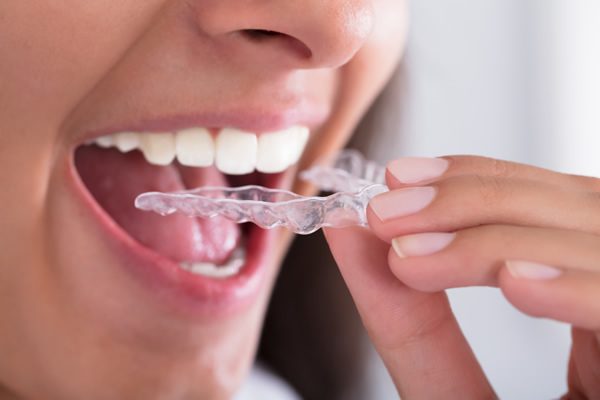
- Clear aligners: attachments tend to cause uneven results, so as a rule whitening is done before or after treatment
Tips for keeping your teeth from looking dull during treatment
The most important way to prevent staining during orthodontic treatment is careful brushing every day. Brush around the appliance one tooth at a time with a single-tuft brush or similar. After strongly colored foods and drinks such as coffee, tea, red wine and curry, even just rinsing with water makes staining less likely. If you use clear aligners, the basic rule is to take them out when drinking anything other than water. Regular professional cleaning to remove stains early is also effective. Smoking also causes staining, so orthodontic treatment can be a good opportunity to cut down. In addition, for 1 to 2 days after whitening, teeth stain more easily, so avoiding strongly colored foods and drinks during that time helps keep them white.
Summary
We recommend doing whitening either before or after orthodontic treatment. Which suits you depends on the type of appliance, when you want to start orthodontics, and whether you have important events coming up. Please ask about whitening as well at your orthodontic consultation.
ESCA Dental & Orthodontic Clinic is in the ESCA underground shopping mall, a 1-minute walk from the Shinkansen exit of JR Nagoya Station. Appointments by phone (+81-52-452-1255), online booking (Japanese) or LINE.
Main risks and side effects
- After whitening, the teeth may be temporarily sensitive (dentin hypersensitivity)
- The whiteness gradually fades over time, so repeat treatments are needed to maintain it
- Crowns and fillings do not whiten, so a difference in color may appear
- During orthodontic treatment, you may feel pain or discomfort as the teeth move
- If brushing is not thorough, the risk of cavities and gum disease increases
Whitening and orthodontic treatment are self-paid (not covered by insurance). Please see our fee table for standard fees.
Frequently asked questions
Q. Can I have whitening during orthodontic treatment?
With lingual braces, in-office whitening may be possible. With front braces or clear aligners with attachments, it is generally done before or after treatment.
Q. Can I start orthodontic treatment right after whitening?
Whitening can affect how well the adhesive for the appliance bonds, so we may leave a short interval. We will advise you on when to start at your consultation.
Q. Will teeth with crowns also become whiter?
Crowns and fillings do not become whiter with whitening. If the difference in color bothers you, they can be remade after whitening.
Related pages
Medical review
This article was reviewed by Katsuaki Takeuchi, DDS (Director; Board-certified oral surgeon, Japanese Society of Oral and Maxillofacial Surgeons), ESCA Dental & Orthodontic Clinic. It provides general information; please consult a dentist about your own condition.
Appointments and questions
Mon–Fri 10:00–13:00 / 14:30–19:30 · Sat & Sun 10:00–13:00 / 14:00–18:00 (open every other Sunday) · Closed on national holidays. Our staff mainly speak Japanese.