
The 4 Causes of Tooth Decay: Bacteria, Sugar, Teeth and Time
Published: 2023-04-24 · Updated: 2026-11-22 · Medically reviewed by Katsuaki Takeuchi, DDS (Director; Board-certified oral surgeon, Japanese Society of Oral and Maxillofacial Surgeons)
What you will learn
- How the four causes of tooth decay work (bacteria, sugar, tooth quality and time)
- Easily overlooked causes such as acidic drinks, dry mouth and stress
- Daily prevention and dental clinic care matched to each cause
Have you ever worried "Is this a cavity?" because a tooth hurts, feels sensitive or looks dark?
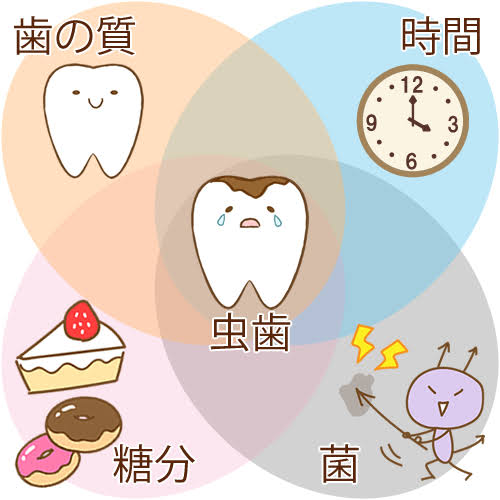
Tooth decay does not come from a single cause. It becomes more likely when four factors overlap: bacteria, sugar, tooth quality and time. In this article, we explain why tooth decay happens in the first place and share prevention tips you can use every day.
How tooth decay forms
Many kinds of bacteria live in the mouth. Among them, the main cause of tooth decay is "cavity-causing bacteria" such as Streptococcus mutans. These bacteria feed on the sugar in food and drinks, form sticky dental plaque, and release acid inside it. This acid dissolves calcium and other minerals from the enamel on the tooth surface. This is called demineralization.
Saliva, on the other hand, neutralizes acid and returns the dissolved minerals to the teeth. This is called remineralization. Normally, demineralization and remineralization repeat and stay in balance. But if you eat sweet things often or plaque stays on the teeth for a long time, demineralization wins out, and eventually a hole forms in the tooth: a cavity.
The four causes of tooth decay
1. Bacteria (cavity-causing bacteria)
Some cavity-causing bacteria produce acid strongly and others weakly, and it is said that the more strong acid-producers you have, the more prone you are to decay. When brushing is not enough and plaque is left on the teeth, these bacteria keep multiplying. Plaque starts to form some time after a meal and becomes harder to remove the longer it stays.
2. Sugar
Cavity-causing bacteria feed on sugar and other carbohydrates to make acid. Foods that stay in the mouth for a long time or stick to the teeth, such as hard candy, caramel, chewing gum and juice, raise the risk of decay. Not only the amount but also how often you eat, and the habit of snacking on and off, make a big difference.
3. Tooth quality
How strong teeth are differs from person to person. Newly erupted teeth and teeth with thin enamel are said to dissolve more easily in acid. Areas where teeth overlap and the deep grooves of back teeth are hard for a toothbrush to reach, so debris tends to remain there. People with less saliva are also more prone to decay because remineralization does not work as well.
4. Time
The longer teeth are exposed to acid, the faster decay progresses. That said, skipping brushing for one night does not immediately cause a cavity. It is said to take a certain amount of time for the bacteria in plaque to become active and dissolve the tooth. What matters is your daily routine.
Other easily overlooked causes
Besides the four main causes, other factors can make decay more likely.
One is acidic drinks. Sports drinks, fizzy drinks, orange juice and black vinegar drinks, which people tend to drink more in hot weather, are strongly acidic and can easily dissolve the tooth surface. Simply stopping the habit of sipping them over a long time and rinsing with water afterwards can make a difference.
Another is a dry mouth. When saliva decreases because of mouth breathing, side effects of medication or age, bacteria multiply more easily. Stress is also said to upset the autonomic nervous system, reducing saliva and making the mouth dry. If you feel you get more cavities during busy periods, this may be part of the reason.

Tooth decay does not heal on its own
Some people think a cavity has healed because "it hurt yesterday, but it is fine today." However, once a hole has formed, the tooth does not return to normal on its own. Tooth decay progresses through stages: very early (CO), enamel only (C1), reaching the dentin (C2), reaching the nerve (C3), and only the root remaining (C4). At the very early stage, careful brushing and fluoride can encourage remineralization and may slow its progress, but the further it advances, the more extensive the treatment becomes. Rather than waiting until it hurts, it is important to find decay early.
Prevention matched to each cause
Against bacteria: brush every day. Place the toothbrush where the teeth meet the gums and move it in small strokes. Clean between the teeth with floss or interdental brushes.
Against sugar: review how you eat. Set times and limits for snacks, and avoid sipping sweet drinks over a long time. After eating, rinse your mouth with water or tea.
Against weak teeth: use fluoride. Using fluoride toothpaste together with fluoride applications at the dental clinic can be expected to strengthen the tooth surface and help remineralization.
And having check-ups and cleanings every 3 to 6 months is the most reliable form of prevention.
Summary
Tooth decay forms when four factors overlap: bacteria, sugar, tooth quality and time. Reducing even one of them brings you closer to a mouth that is less prone to decay. Combine daily self-care with regular check-ups and cleanings at the dental clinic to protect your teeth. If anything concerns you, please feel free to consult us.
ESCA Dental & Orthodontic Clinic is in the ESCA underground shopping mall, a 1-minute walk from the Shinkansen exit of JR Nagoya Station. Appointments by phone (+81-52-452-1255), online booking (Japanese) or LINE.
Frequently asked questions
Q. Will I get a cavity if I skip brushing for one day?
A cavity does not form right away, but as plaque builds up, bacteria multiply and can cause tooth decay and gum disease. Making a habit of careful brushing every day is important.
Q. If I avoid sweets, will I never get cavities?
Sugar is a major cause, but tooth quality, the amount of saliva, how well you brush and how often you eat also play a part. Besides cutting down on sweets, it is important to take an all-round approach to prevention.
Q. Can early tooth decay heal?
At the very early stage before a hole forms, brushing and fluoride can encourage remineralization and may slow its progress. Once a hole has formed, decay does not heal on its own.
Related pages
Medical review
This article was reviewed by Katsuaki Takeuchi, DDS (Director; Board-certified oral surgeon, Japanese Society of Oral and Maxillofacial Surgeons), ESCA Dental & Orthodontic Clinic. It provides general information; please consult a dentist about your own condition.
Appointments and questions
Mon–Fri 10:00–13:00 / 14:30–19:30 · Sat & Sun 10:00–13:00 / 14:00–18:00 (open every other Sunday) · Closed on national holidays. Our staff mainly speak Japanese.