
Pros and Cons of Orthodontic Treatment: What to Know Before Starting
Published: 2025-04-22 · Updated: 2026-11-22 · Medically reviewed by Katsuaki Takeuchi, DDS (Director; Board-certified oral surgeon, Japanese Society of Oral and Maxillofacial Surgeons)
What you will learn
- The benefits orthodontic treatment can offer for appearance and health
- Disadvantages and risks to know about, and how to reduce them
- Four things to check at your consultation so you have no regrets

Many people hesitate, wondering "I would like to try orthodontics, but do I really need it?" or "Will I regret it after starting?" Orthodontic treatment has benefits not only for appearance but also for oral health, but it also has disadvantages, such as taking time and causing pain.
In this article, we sort out the advantages and disadvantages of orthodontic treatment and explain what you should check before starting.
Advantages of orthodontic treatment
Changes in appearance and the look of your mouth
Many people tell us that once their teeth were aligned, they could smile without covering their mouth with their hand. For people concerned about protruding teeth or a protruding mouth, moving the front teeth back can be expected to give a neater profile. When teeth are extracted to bring the mouth back, some people feel the impression of their face has changed.
A better bite and better chewing
When the upper and lower teeth meet correctly, it becomes easier for them to do their natural work: biting food off with the front teeth and grinding it with the back teeth. A poor bite tends to put strain on certain teeth and the jaw joints, which can wear down teeth or make the jaw tire easily. Correcting the bite can be expected to reduce this strain.
Easier brushing
Where teeth overlap, the toothbrush has trouble reaching and debris builds up easily. When the teeth are aligned, brushing becomes easier, which helps prevent tooth decay and gum disease. Also, when the mouth closes more easily, dryness decreases and saliva washes debris away more easily. Some people also find it easier to pronounce words.
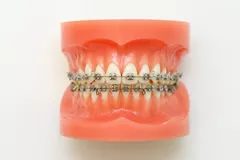
Disadvantages and risks of orthodontic treatment
On the other hand, orthodontic treatment has the following disadvantages and risks. Many of them can be reduced by knowing about them in advance and taking measures.
First, treatment takes a long time. Unlike treatments that improve appearance with crowns, orthodontics moves the teeth themselves, so full orthodontic treatment generally takes years. Even after the teeth are aligned, a period of wearing a retainer is needed to prevent relapse.
Second, there is pain and discomfort. Right after the appliance is fitted or after an adjustment, a pressing pain in the teeth often lasts about 2 to 3 days and usually settles in about a week.
Also, debris builds up easily around the appliance, so if brushing is not thorough, tooth decay and gum disease become more likely. Other possible effects include slight shortening of the roots (root resorption), gum recession, and, in rare cases, a weakened nerve causing the tooth to change color. The treatment plan may also be revised during treatment, depending on how the teeth move.
What to check at your consultation so you have no regrets
- How long the treatment period is, and how long the retention (retainer) period is
- The total cost, including the appliance, adjustment fees, examination fees and retention costs
- How pain will be handled, and how to contact the clinic if you have a problem
- Whether treatment for tooth decay or gum disease is needed first
For costs in particular, it is reassuring to check the total, including not just the appliance but also the adjustment fee at each visit and any treatment for tooth decay or gum disease needed before orthodontics. Aligner-type appliances are removable, but if they are not worn for the set time, the teeth do not move as planned, so whether an appliance fits your lifestyle is also an important point. At our clinic, general dentistry and orthodontics are provided at the same clinic, so if tooth decay or other problems are found during orthodontic treatment, you can be treated here as well.
Summary
In addition to changing your appearance, orthodontic treatment has benefits for protecting your teeth over the long term, such as a better bite and easier brushing. At the same time, it has disadvantages you should know about, such as the treatment period, pain and the need for self-care. We explain both the advantages and disadvantages carefully at your consultation so that you can start treatment with full understanding.
ESCA Dental & Orthodontic Clinic is in the ESCA underground shopping mall, a 1-minute walk from the Shinkansen exit of JR Nagoya Station. Appointments by phone (+81-52-452-1255), online booking (Japanese) or LINE.
Main risks and side effects
- During orthodontic treatment, pain or discomfort may occur as the teeth move
- If brushing is not thorough, the risk of tooth decay and gum disease increases
- Roots may become shorter (root resorption) and gums may recede. After treatment, teeth may move back if the retainer is not used
- In rare cases, the nerve of a tooth may weaken and the tooth may change color
Orthodontic treatment is self-paid (not covered by insurance). Costs vary depending on the appliance and treatment period, so we explain them after a detailed examination (see our fee table for a guide).
Frequently asked questions
Q. How long does orthodontic pain last?
It is usually strongest for 2 to 3 days right after the appliance is fitted or after an adjustment, and often settles in about a week. How it feels varies from person to person.
Q. Can I have orthodontic treatment if I have a post crown?
Because the root remains with a post crown, in most cases the tooth can be moved with orthodontics. Depending on the condition of the root, we adapt the treatment plan.
Q. From what age can aligner orthodontics be started?
In some cases, it can be started around age 10, when baby teeth and permanent teeth are mixed. The right time to start depends on growth, so please consult us early.
Medical review
This article was reviewed by Katsuaki Takeuchi, DDS (Director; Board-certified oral surgeon, Japanese Society of Oral and Maxillofacial Surgeons), ESCA Dental & Orthodontic Clinic. It provides general information; please consult a dentist about your own condition.
Appointments and questions
Mon–Fri 10:00–13:00 / 14:30–19:30 · Sat & Sun 10:00–13:00 / 14:00–18:00 (open every other Sunday) · Closed on national holidays. Our staff mainly speak Japanese.