
Why Teeth Look Yellow: Surface Stains vs. Internal Discoloration
Published: 2025-04-17 · Updated: 2026-11-22 · Medically reviewed by Katsuaki Takeuchi, DDS (Director; Board-certified oral surgeon, Japanese Society of Oral and Maxillofacial Surgeons)
What you will learn
- The difference between surface stains and internal discoloration, and their causes
- Why Japanese people's teeth tend to look yellowish, and a guide to tooth shades
- Options for stains and discoloration (professional cleaning, whitening and more)

Have you ever looked in the mirror and wondered whether your teeth have changed color, or whether they are more yellow than other people's?
Concerns about tooth color have two main causes: surface stains and internal discoloration. Both make teeth look a different color, but their causes and remedies differ. In this article, we explain the difference between them, how to tell them apart, and what can be done about each.
What are tooth stains?
Stains occur when pigments from outside attach to the tooth surface. The tooth surface is covered with a thin film called the pellicle, and pigments from food, drink and tobacco stick to this film and to plaque and tartar left from brushing, gradually forming brownish deposits.
Common causes of staining are drinks such as coffee, black tea, green tea and red wine, foods such as curry, chocolate and blueberries, and tobacco tar. If brushing is not thorough, stains build up even more easily.
A feature of stains is that the tooth surface turns brownish or yellowish and may feel rough. Because they are deposits on the surface, they are relatively easy to remove with professional cleaning at a dental clinic.
What is tooth discoloration?
Discoloration is a change in the color of the tooth itself, caused by something inside the tooth. A feature is that it is hard to improve by polishing the surface.
One main cause is aging. With age, the enamel gradually becomes thinner, and the yellowish dentin inside shows through, making teeth look more yellow. Teeth whose nerve has been damaged by decay or a blow may also turn darkish. Teeth may also be gray or brownish because of taking tetracycline antibiotics for a long time in early childhood. In addition, metal from silver fillings can dissolve and make a tooth look darkish.
Why Japanese people's teeth tend to look yellowish
Tooth color varies greatly from person to person depending on ethnicity, lifestyle and other factors, and the thickness of the enamel plays a particular role. Enamel is translucent, and the dentin under it is yellowish. Japanese people are said to have relatively thin enamel, so the color of the dentin shows through and teeth tend to look yellowish.
At a dental clinic, tooth color is checked against a color sample called a shade guide. Many Japanese people have A-series shades (reddish-brown base), and A3 to A3.5 is said to be standard. For someone whose original shade is A3.5, even A2 gives a clearly brighter impression.
How to tell stains from discoloration
- The tooth surface is brownish and rough: likely a stain (often improved by professional cleaning)
- All the teeth look somewhat yellow: possibly age-related discoloration (whitening may brighten them)
- Only one tooth is darkish or gray: possibly discoloration from nerve damage or similar (have the cause checked at a dental clinic)
In reality, stains and discoloration often occur together, and they can be hard to tell apart yourself. If you are concerned, have them checked at a dental clinic.
What to do about stains
Stains take a little time to form, so they are fairly easy to prevent with daily brushing. Brush carefully after meals, and if you cannot brush right away, rinse your mouth with water. Using a straw for dark drinks reduces contact with the teeth. Toothpaste with stain-removing ingredients is one option, but scrubbing hard with a highly abrasive toothpaste can damage the teeth, so brush gently.
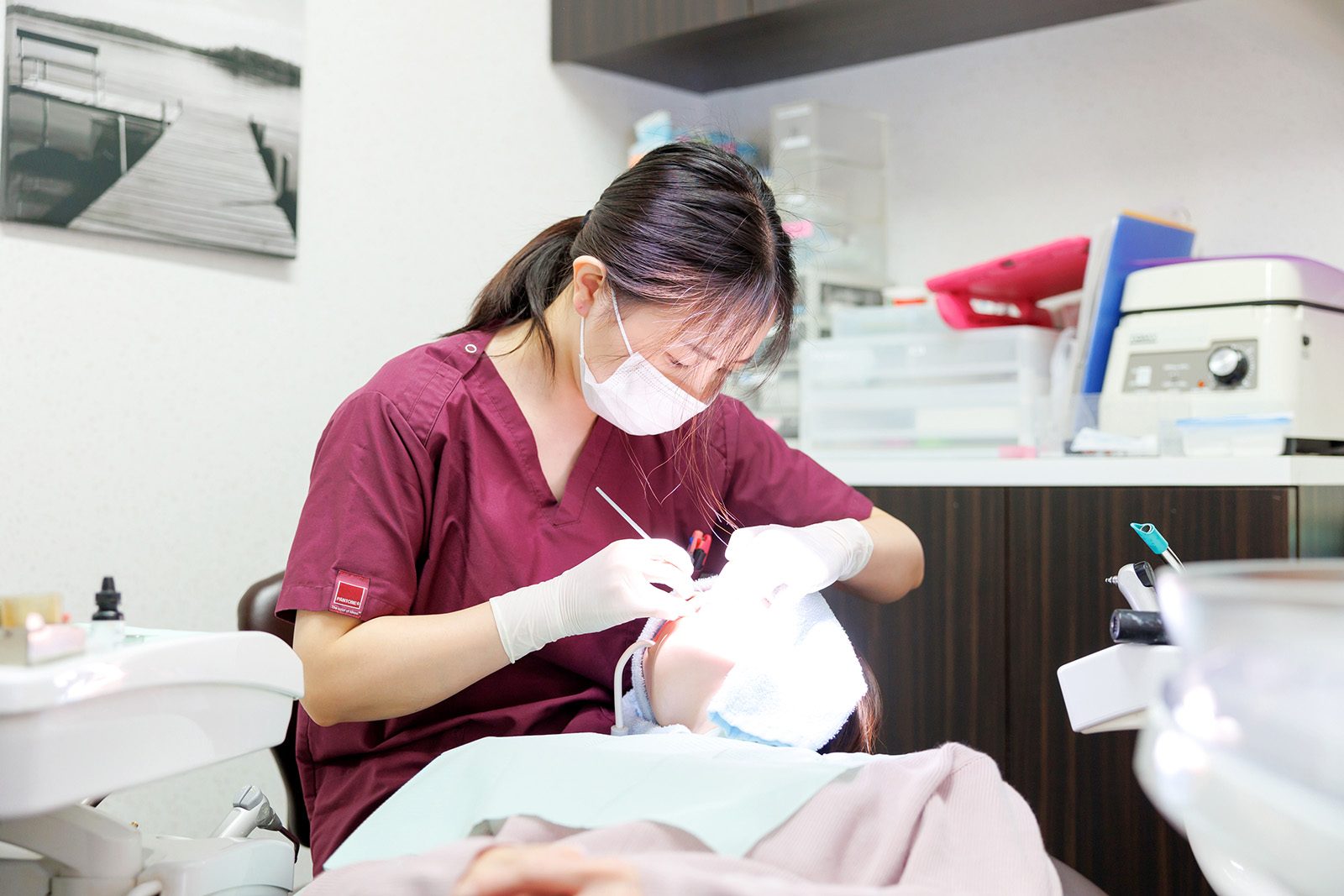
Stains that have already formed can be removed with professional cleaning at a dental clinic (PMTC) or Air-Flow, which removes deposits by spraying a fine powder. Air-Flow removes not only stains but also bacterial masses (biofilm), so it also helps prevent cavities and gum disease. It is also suited to cleaning hard-to-brush places, such as around orthodontic appliances.
What to do about discoloration
For overall yellowing due to age and similar causes, whitening can brighten the teeth. There is in-office whitening done at the dental clinic and home whitening done at home. For discoloration of a tooth whose nerve has been removed, there is a method of whitening from the inside by placing an agent inside the tooth (walking bleach). If whitening does not improve the color well, the color can also be adjusted with ceramic crowns or similar. If the cause is decay or a nerve problem, that must be treated first.
Note that teeth whitened too much can look unnatural. Let's decide on a brightness that suits you while checking against the shade guide.
Summary
Yellow teeth can be caused by surface stains or by internal discoloration, and each needs a different approach. It is important to choose a method that suits the cause: professional cleaning for stains, and whitening or ceramics for discoloration. If anything concerns you about the color of your teeth, please feel free to consult us.
ESCA Dental & Orthodontic Clinic is in the ESCA underground shopping mall, a 1-minute walk from the Shinkansen exit of JR Nagoya Station. Appointments by phone (+81-52-452-1255), online booking (Japanese) or LINE.
Main risks and side effects
- During or after whitening, teeth may become sensitive (dentin hypersensitivity)
- If the agent touches the gums, it may cause a stinging sensation
- Results vary from person to person, and the color may gradually return over time. Fillings, crowns and artificial teeth do not whiten
Whitening is self-paid (not covered by insurance). Please see our fee table for standard costs.
Frequently asked questions
Q. Can stains be removed by brushing?
Stains that have just started are easier to remove with daily brushing. Stains that have built up can be removed with professional cleaning at a dental clinic.
Q. Can age-related yellowing be whitened?
Whitening may brighten the teeth. Results vary from person to person, so please consult us after an examination.
Q. Why is only one tooth darkish?
Possible causes include nerve damage, decay or the effect of metal. The remedy depends on the cause, so have it checked at a dental clinic.
Related pages
Medical review
This article was reviewed by Katsuaki Takeuchi, DDS (Director; Board-certified oral surgeon, Japanese Society of Oral and Maxillofacial Surgeons), ESCA Dental & Orthodontic Clinic. It provides general information; please consult a dentist about your own condition.
Appointments and questions
Mon–Fri 10:00–13:00 / 14:30–19:30 · Sat & Sun 10:00–13:00 / 14:00–18:00 (open every other Sunday) · Closed on national holidays. Our staff mainly speak Japanese.