
Black Spots on Teeth: Cavity or Stain? Signs and Treatment
Published: 2026-06-19 · Updated: 2026-11-22 · Medically reviewed by Katsuaki Takeuchi, DDS (Director; Board-certified oral surgeon, Japanese Society of Oral and Maxillofacial Surgeons)
What you will learn
- The difference between a black spot that is a cavity and one that is a stain
- How cavities progress, and the early sign (white spots)
- Treatment for black spots, and when we monitor without drilling

When you look in the mirror while brushing and spot a black dot on the chewing surface of a back tooth or between teeth, it is natural to worry that it might be a cavity.
A black spot on a tooth may be a cavity, or it may be a stain. In this article, we explain how to tell them apart and how cavities are treated.
What could a black spot be? Three possibilities
- A cavity: the tooth has dissolved and looks dark
- A stain: pigments from coffee, tea, tobacco and so on have settled into grooves or gaps
- An arrested cavity: an old cavity has hardened and turned black (it has remineralized and is not progressing)
It is often hard to tell them apart just by looking. At the dental clinic, we judge by combining how the spot feels to an instrument, X-rays, and a magnified view.
Signs that a black spot is likely a cavity
- The dark area is soft or has a hole
- The area around the black spot looks cloudy white
- Cold or sweet things cause sensitivity, or there is pain
- Food tends to get stuck there
- It does not come off with brushing
A black spot in the groove of a back tooth may look small on the surface but can be spreading inside. A dark shadow between teeth can also be a cavity, so it needs attention.
How cavities progress
Cavities progress step by step: the outer enamel (white spots, black dots) → the dentin inside (sensitivity, a hole) → the nerve (throbbing pain) → the tip of the root (swelling, pus). Dentin is softer than enamel, so once decay reaches it, it spreads faster. Even a small black spot should be checked rather than ignored.
White spots may be a sign of an early cavity
Cavities do not suddenly turn black. At first, the enamel on the surface starts to dissolve and may appear as a cloudy "white spot." At this stage, we can sometimes monitor it without drilling, with fluoride application and careful brushing.
If you find a white spot, have it checked at a dental clinic early.
Treatment if it is a cavity
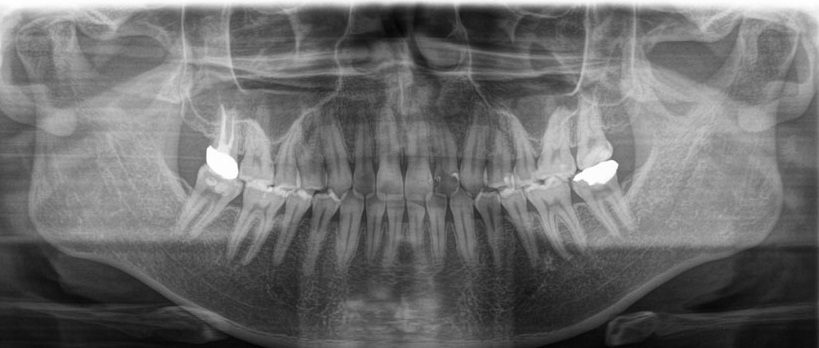
If the cavity is small, we remove only the decayed part and fill it with a white resin (composite resin); this is often finished in one visit. Local anesthesia is often used, which keeps pain during treatment under control.
If the cavity is large, we may take an impression and make a filling (inlay) or crown. If the decay has reached the nerve, root canal treatment is needed. The earlier it is found, the less tooth needs to be removed and the fewer visits are needed.
Sometimes we monitor without drilling
If it is only a stain, or a cavity that has stopped progressing and hardened, we may not drill right away and instead monitor it at regular checkups. In that case, we use intraoral photos and X-rays to check whether it has changed since the last visit.
If stains bother you, they can sometimes be removed with professional cleaning (such as Airflow).
Preventing black spots and cavities
- Brush the grooves of back teeth carefully, holding the bristle tips upright against them
- Clean between teeth with floss
- Use a fluoride toothpaste
- Do not snack on sweets or sweet drinks throughout the day
- Rinse your mouth with water after dark-colored drinks
- Have a checkup about once every 3 to 6 months
Children's back teeth have deep grooves that are prone to cavities, so another option is to fill the grooves with a resin called a sealant to help prevent cavities. If you are interested, ask at your child's pediatric dental checkup.
Summary: if you find a black or white spot, get it checked early
A black spot on a tooth may be a cavity or a stain. Rather than judging it yourself, have it checked at a dental clinic early if it worries you. Finding problems early helps protect your teeth.
ESCA Dental & Orthodontic Clinic is in the ESCA underground shopping mall, a 1-minute walk from the Shinkansen exit of JR Nagoya Station. Appointments by phone (+81-52-452-1255), online booking (Japanese) or LINE.
Main risks and side effects
- After a cavity is treated by drilling, the tooth may be sensitive for a while
- Fillings can discolor, wear or chip over time and may need to be replaced
Frequently asked questions
Q. I have a black spot but it does not hurt. Does that mean it is not a cavity?
Even a cavity may not hurt in the early stages or when it progresses slowly. Even without pain, have it checked at a dental clinic if it concerns you.
Q. If it is a stain, can I remove it myself?
Light surface stains may become less noticeable with brushing. Stains that have settled into grooves are hard to remove, so we recommend professional cleaning at a dental clinic.
Q. My child has a black spot on a tooth.
Baby teeth are softer than adult teeth, and cavities tend to progress faster. Have it checked at a pediatric dentist early.
Medical review
This article was reviewed by Katsuaki Takeuchi, DDS (Director; Board-certified oral surgeon, Japanese Society of Oral and Maxillofacial Surgeons), ESCA Dental & Orthodontic Clinic. It provides general information; please consult a dentist about your own condition.
Appointments and questions
Mon–Fri 10:00–13:00 / 14:30–19:30 · Sat & Sun 10:00–13:00 / 14:00–18:00 (open every other Sunday) · Closed on national holidays. Our staff mainly speak Japanese.